 E2B / SANDBOX A[01]
CODE AGENT Pi Harness
CALLS → GitHub
 Linear
GitHubLinear
Your interface. Your infrastructure stack.
Embed agents into the product you already build.
Many Sandboxes. Many Harnesses. Many tools.
Your backend turns one release review into separate Sessions and Runs.
 HEXAGONSESSION / RUN / EVENTSE2BBOX APi Harness
 ModalBOX B
 OpenCode
 VercelBOX C
 Codex


Headless execution. Native to your product.
All Harnesses. All Sandboxes. Your tools.
A button, a workflow, a background job. Keep your interface and your users. Add agent execution through your backend.
Your UI. Your brand. Your users.
session = createSession(…)run = submit(…) HEXAGON API
Stream events. Deliver results.
Keep credentials server-side.
E2B / SANDBOX A[01]Pi HarnessGitHubLinearMODAL / SANDBOX B[02]OpenCode HarnessExaNotionVERCEL / SANDBOX C[03]Codex HarnessSlackYour APIThe interesting part starts after the prompt. Give your agents a workspace, continuity and scoped access — with a clear record of what happened.
Bind a Sandbox, a versioned Harness and a model endpoint to each Session. Your application owns the experience.
Session lifecycle ↗Keep original provider and upstream credentials in the control plane. Give task code scoped authority through protected connections.
Understand the boundary ↗Observe durable Run events and resume from a committed cursor. Losing the client connection does not cancel the work.
Execution and recovery ↗Lifecycle above. Execution below.
Choose a layer to see what belongs where.
Sessions, Runs, cloud resources and durable events live in the control plane. PostgreSQL persists the state. Your application connects through one headless API.
HEXAGON CONTROL PLANESessions · Runs · Events · AccessEmbed execution with Python, TypeScript or REST. Create a Session, submit a Run, and deliver its events and results through your own application.
Submission returns a Run, not a completed answer. The complete guide covers result polling, artifacts and cleanup.
The fleet above is one illustration. Choose compatible Sandbox, Harness and tool connections for your own application.
E2BModalVercel Blaxel
 Sprites
 Fly Machines
 Upstash
 Instabox
 Freestyle
 BoatPiOpenCodeCodex
 Hermes
 OpenClaw
 Aider
 Claude Code
 DeepSeek
 Custom OCIGitHubLinearSlackNotionExa
 Firecrawl
 Google Drive
 MCPYour API
Each Session pins its own configuration. Catalog availability does not imply that every combination is supported. View verified combinations ↗
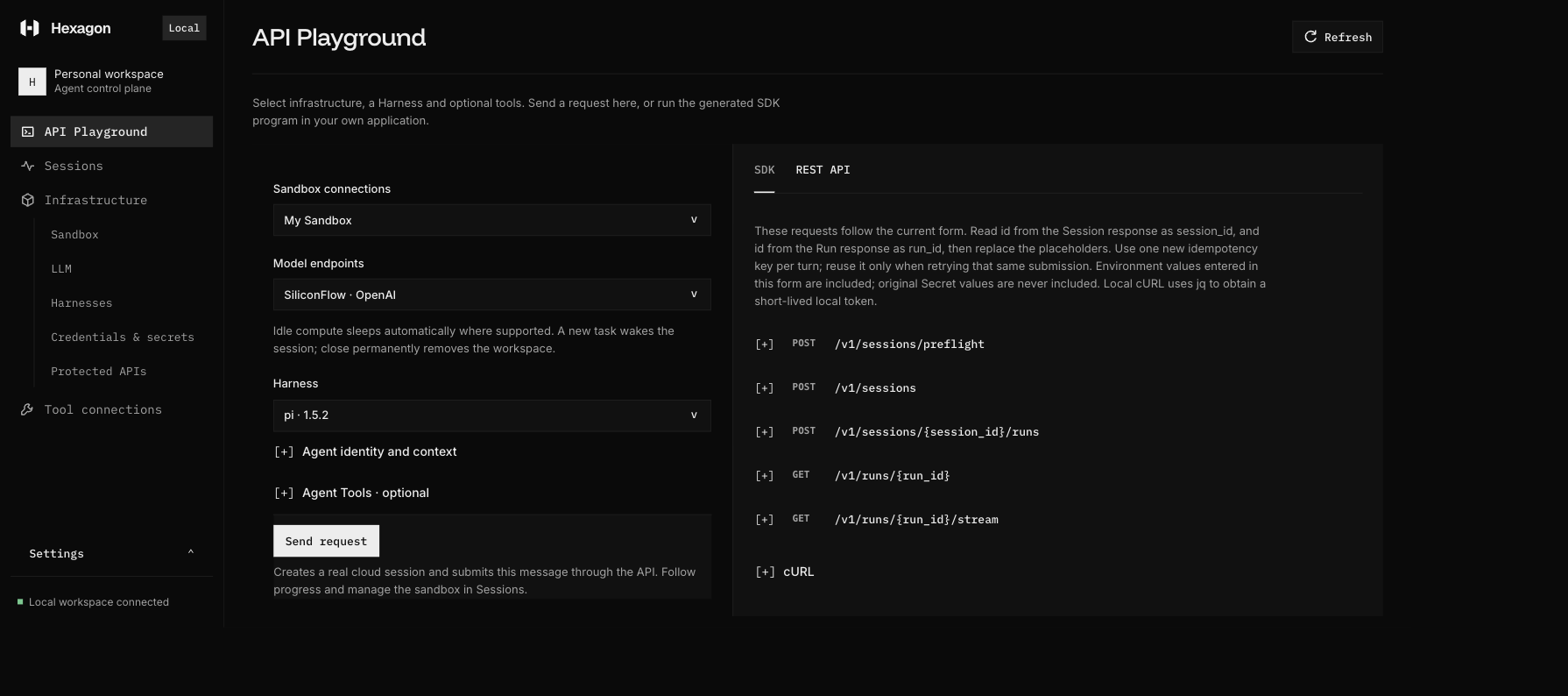
Configure connections. Inspect the request. Follow a Run through execution. Console is your operations surface.
No. Hexagon orchestrates execution on your connected cloud Sandbox accounts. Local versus hosted describes the control plane, not where agent execution runs.
Choose a compatible versioned Harness. Built-in Pi and OpenCode are available, alongside OCI adapters and templates. Check the exact provider, distribution and model protocol before running.
The Run continues. Reconnect with the original Run identity to inspect durable events. Cancellation and closing a Session are explicit operations.
Hexagon is in developer preview. Real-cloud evidence is scoped to specific combinations; it is not a universal compatibility guarantee or a stable-release SLA. Review the support ledger before deployment.
Read the support ledger ↗Your connected cloud and model accounts fund execution. Lifecycle behavior and idle billing depend on the provider. Close unused Sessions and confirm resource cleanup.